
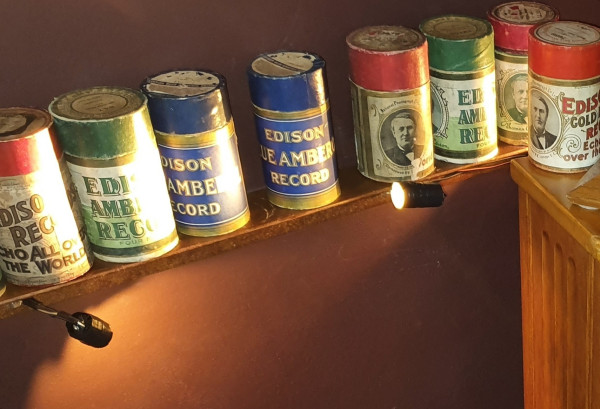
A set of 18 well-preserved cylinders from the golden age of the phonograph—spanning 1910 to 1920—produced under the Edison Record label. These cylinders offer a captivating glimpse into musical and audio history. Made of either wax or amberol celluloid, they hold recordings of popular music, spoken word, and operatic arias, once enjoyed on phonographs developed by Edison.
The inner core of these cylinders was typically made of plaster, providing a solid and stable foundation for the outer layer. Starting in 1912, the wax coating was replaced with nitrocellulose (also known as celluloid, an early form of plastic). This innovation allowed up to 4 minutes of recording per cylinder. However, this advancement could not prevent the revolution that began in 1919—the advent of mass-produced vinyl records—which essentially marked the abrupt end of the phonograph era.