
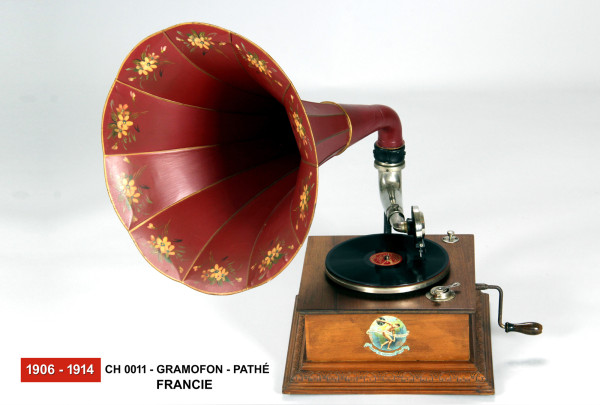
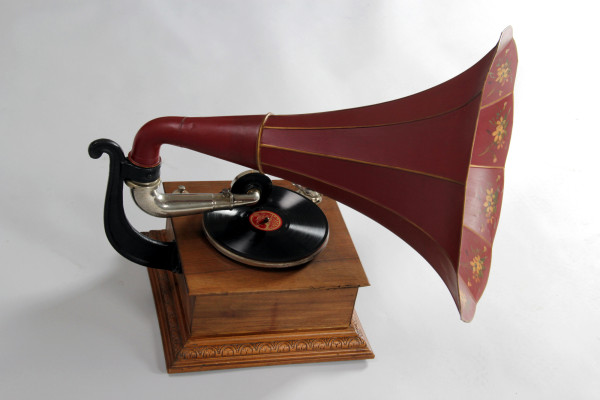
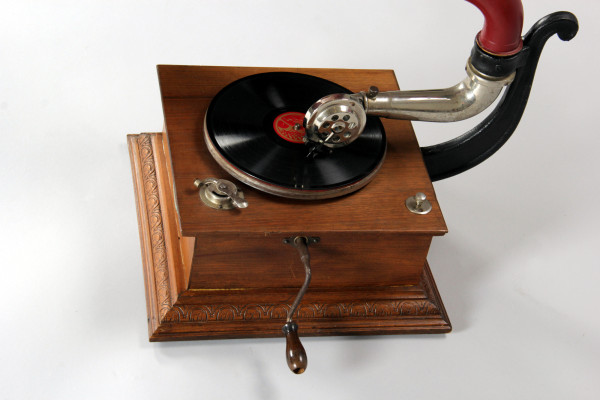
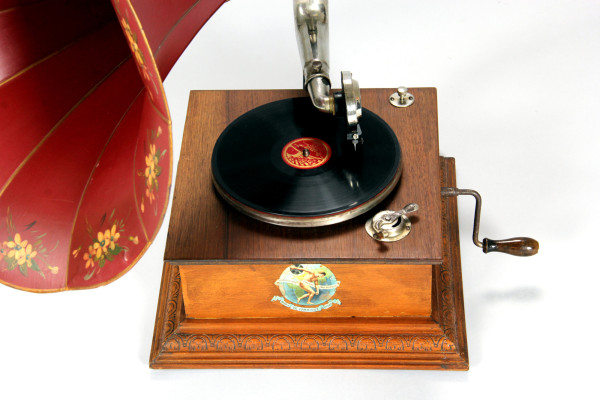
The gramophone featuring a drawing of a Discobolus on its front panel was crafted in the workshops of the renowned French company Pathé Frères, which sold its innovative gramophones worldwide.
The Pathéphone Type 2 was designed to play Pathé records with the so-called vertical recording method (hill-and-dale). What made this vertical recording unique? Unlike the more common lateral recording, which used a side-to-side motion of the needle, vertical recording employed an up-and-down movement, creating a wavy pattern in the record's grooves.
Pathé Frères began producing vertically recorded discs in 1905. The first records were single-sided and featured a wax layer on a concrete base, but later, they transitioned to shellac. These records required a special spherical sapphire needle, which, among other advantages, eliminated the need to change the needle after every playback. This innovation is reflected in the illustration of the athletic young man throwing a discus, promoting the idea that "Pathé discs play without (steel) needles." More importantly, these precision needles, along with the vertical recording method, provided listeners with an unparalleled sound experience for the standards of the time.The gramophone featuring a drawing of a Discobolus on its front panel was crafted in the workshops of the renowned French company Pathé Frères, which sold its innovative gramophones worldwide.
The Pathéphone Type 2 was designed to play Pathé records with the so-called vertical recording method (hill-and-dale). What made this vertical recording unique? Unlike the more common lateral recording, which used a side-to-side motion of the needle, vertical recording employed an up-and-down movement, creating a wavy pattern in the record's grooves.
Pathé Frères began producing vertically recorded discs in 1905. The first records were single-sided and featured a wax layer on a concrete base, but later, they transitioned to shellac. These records required a special spherical sapphire needle, which, among other advantages, eliminated the need to change the needle after every playback. This innovation is reflected in the illustration of the athletic young man throwing a discus, promoting the idea that "Pathé discs play without (steel) needles." More importantly, these precision needles, along with the vertical recording method, provided listeners with an unparalleled sound experience for the standards of the time.