
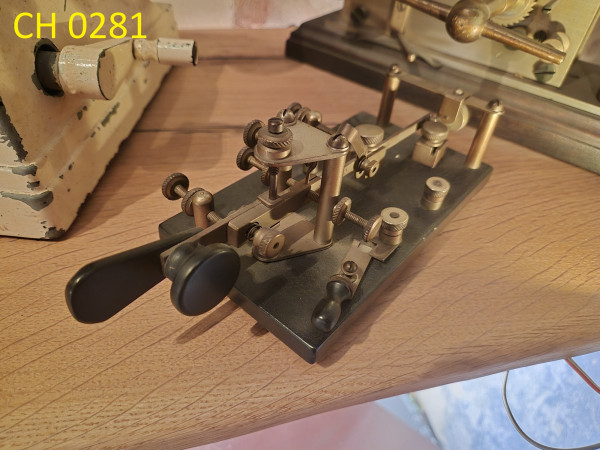
This is a so-called “double-action” telegraph key (in English, “double-action key” or more commonly “sideswiper,” sometimes also called a “cootie key”). It is a special type of telegraph key that differs from the standard (classic) key in its operation and construction. The telegraphist holds the lever between the fingers and, by moving it sideways (to the right and left), alternately connects the contacts. Each touch of the lever to a contact sends a signal (a dot or a dash) – depending on the length of the touch.
The contacts are wired in parallel, so it doesn't matter whether the lever is moved to the right or to the left – the signal is always the same.
This method allows for faster and smoother transmission, and this type of motion is also less strenuous for the hand than repeated downward pressing. It’s interesting, then, that it never became more widespread.